


Does the TCPUD add any chemicals to the water?
Yes, chlorine, in the form of 12.5% sodium hypochlorite (liquid bleach) is added to most TCPUD water sources. This is added to maintain a safety barrier for the customer in the unlikely event some type of pathogenic organism contamination occurs. Although the chlorine is often noticeable by taste and smell, we maintain very low chlorine residuals (0.2 to 0.3 parts per million) to provide an adequate safety barrier while minimizing the effect on the taste and odor of the water. Occasionally, higher levels of chlorine are required during system maintenance; however these levels should return to normal within 2-48 hours, and do not pose a health threat. |
Does the TCPUD add flouride to my water?
Currently the TCPUD does NOT add flouride to its drinking water. |
How can I locate my water service box in the winter time?
There are several different water providers within the TCPUD service area. Please refer to the Water Service Area Map located in the maps link under Your Government. |
How do I winterize the water system in my house?
The most convenient and popular way to winterize your home is by the customer installing a stop and drain valve in a location accessible year round. This valve allows the customer to conveniently shut off their water, and when closed allows the internal house piping to drain out, preventing freezing pipes in cold temperatures. In addition it provides the customer an easy location to shut off their water for repairs to their plumbing, without having to call out the TCPUD for a water turn off/on, which has a service charge minimum of $35.00. Running bleeders to prevent frozen pipes is NOT an acceptable practice, and is an enforceable violation of the TCPUD Ordinance No. 263. Contact a local plumber for more information on stop and drain valves. |
I have a sewer easement on my property, what does this mean?
Sewer line easements allow the TCPUD to operate and maintain sewer facilities on property other than State or County right of ways. This easement area is to remain free from the erection or placement of any structures such as fences, outbuildings and decorative rocks. In addition, landscaping in these areas is hightly discouraged. The TCPUD will not be responsible for damage to any structures or landscaping which are located within the easement boundaries, should access for operation, maintenance or repair be required. |
My sewer backed up, and the plumber who came out and cleared it said I have roots in my line. What can I do about that?
It is important to ask the plumber to inform you of approximately where the root blockage was. If the blockage occured on the house sewer service line between the property line and the home, it is the customer's responsibility to repair. If the blockage appears to be between the property line and the street, please notify the TCPUD and we will investigate if repairs are necessary. |
My water pressure is too low, can you increase it?
The TCPUD water system pressure is based on elevation change between the water storage tank and the point of delivery. In some instances, homes with an elevation close to that of the tank (within 80 feet) will have a normal pressure of 35 psi or less, with even less pressure in upper level facilities. This is normal and for the most part can't be improved. In some cases, customers have installed small booster pumps in their home to increase the operating pressure. If your pressure has decreased over time and you suspect a problem please call the TCPUD for assistance. |
What does the TCPUD do to ensure that my drinking water is safe?
All of the TCPUD water sources and distribution systems are operated in compliance with the California Safe Drinking Water Act. These regulations provide all guidelines to ensure the customer receives water that is safe and pleasant for consumption. These regulations include a water quality monitoring schedule which requires the TCPUD to perform periodic sampling of the water to ensure its safety and quality. Results of this sampling are provided to the customer on an annual basis in a report known as the Consumer Confidence Report. Click here to view the current version of this report. For more specific questions please contact the TCPUD. |
What is the TCPUD responsible for?
The TCPUD is responsible for maintenance and repair of all water mains and service extentions. The service extentions begin at the distribution main and end at the curb stop or valve located on the street or easement side of the service box. |
Where are my sewer cleanouts located?
Typically, there are a minimum of two cleanouts. One is located within 5 feet of the property line, and the other within 5 feet of the building foundation. Maintenance of, and keeping cleanout boxes exposed is the customer's responsibility. It is a good idea to snow stake your cleanouts in the winter time and make sure the boxes are exposed and visible in the spring. If you have trouble locating your cleanouts, the TCPUD may be able to provide you with a map which may assist you. |
Where does my water come from?
Currently, the majority of the water provided by the TCPUD comes from deep groundwater wells located in various locations in the Lake Tahoe Basin. Water for the McKinney/Quail water system is also supplemented in the summer months from a surface water treatment plant that treats water from Lake Tahoe. |
Where does the sewer flow from my house end up?
Sewage collected from the North and West shores of Lake Tahoe converges in Tahoe City and flows in a 36" pipe along the Truckee River corridor to the Tahoe-Truckee Sanitation Agency (TTSA) wastewater treatment plant located on the eastern side of Truckee. |
Where is my water meter/shutoff box located?
The location of the customer's water meter/shutoff box varies, but is typically located at one of the front property corners. Many areas in the Highlands subdivision have their water meter/shutoff box located behind their homes within well-defined public utility easements. |
Who is my water provider?
There are several different water providers within the TCPUD service area. Please refer to the Water Service Area Map. |
Who is responsible for locating and maintaining my water meter/shutoff box and the water line from the box to the house?
The customer is responsible for locating and maintaining the water meter/shutoff box and the water line from the box to the house. The TCPUD may, at the request of the customer, field locate water lines and facilities if TCPUD personnel and equipment are available. The customer shall reimburse the District a standard service charge plus any additional charges for this request. When the District record drawings do not show locations for water services, the District will locate and identify services, including field locations, at no expense to the customer. |
Why do I get two sewer bills?
You are billed by the TCPUD for sewer collection costs, and by TTSA for sewer treatment costs separately. |
How do I know what the results of these tests are?
The numerous and ongoing tests for contaminants such as; lead, arsenic, copper and bacteria are summarized in an annual water quality report. This report, known as the Consumer Confidence Report, must be published and made available to all customers by June 30th each year. Notices that the Consumer Confidence Report is available are mailed to each customer (owner of record) and posted to our website. We encourage customers to view the report on our website. However, we can provide hard copies by mail upon request. Please call (530) 580-6325 if you would like a copy mailed to you. |
How many and how often are tests performed?
As part of our overall Water Quality Program, TCPUD water utility staff regularly collect water over 300 samples annually throughout the District. All water samples are evaluated by certified, third party environmental laboratories accredited by the State of California, Environment Laboratory Accreditation Program (ELAP). Distribution system bacteriological monitoring is required by the State Water Resources Control Board (SWRCB) and by the US EPA through the Total Coliform Rule. The objective of this testing is to monitor for the presence of certain bacteria which may be an indicator of other pathogens in the drinking water. TCPUD takes total coliform samples weekly, totaling approximately 240 per year, to ensure all water going through the distribution system is absent of bacteria and complies with the Total Coliform Rule. Source water bacteriological monitoring is also required by SWRCB. Samples are taken quarterly at each of the District’s active water sources to monitor the source water, like the distribution system, for bacterial activity. Additionally, these tests are required monthly at the water treatment plant that serves the Chamberlands/McKinney area during summer operation. Disinfectant residual and disinfection byproducts monitoring are required by the US EPA Disinfection ByProducts Rule. Monitoring is performed regularly and reports are provided to SWRCB quarterly. The purpose of this testing is to ensure the trace amounts of chlorine used to keep the system disinfected and any possible byproducts generated by the disinfectant both remain below the maximum allowable levels. Lead and Copper Rule monitoring is also performed every three years for each TCPUD system. These tests are ideally performed at residences which were typically built after 1982 and before 1986 which have a higher likelihood of having internal plumbing consisting of copper pipes that were joined using lead containing solder. Lead containing solder was banned in 1986 by the State of California. Samples are taken within individual residences under strict guidelines to ensure test accuracy. It was this testing and the resulting issues that put Flint, MI in the news. |
Is TCPUD water at risk for lead contamination?
The TCPUD is not aware of any lead service pipes in our water system or in our customers pipes and the amount of lead containing solder used to join copper pipes in our area’s households is very low. However, we routinely test for lead and copper using a strict protocol and the cooperation of homeowners to properly obtain samples from their homes. For more information, contact the TCPUD Utilities Department at (530) 580-6278. |
Is TCPUD water tested?
Yes, TCPUD water is tested regularly to ensure your water meets or exceeds all State and Federal drinking water standards. Much of this testing is required by law and includes State oversight, but additional tests or increased testing frequency are routinely performed by TCPUD as internal measures to ensure an even higher standard in water quality and safety. |
What do these test results really mean?
We recognize that the there is a lot of information contained in the consumer confidence report. However, in its basic form the consumer confidence report presents customers with the levels of detected contaminants in your water, what the acceptable levels of these contaminants are, and what the potential health effects of the detected contaminants might be. We are pleased to report that all standards are currently met or exceeded by TCPUD water. If you have specific questions or want a more detailed explanation of the test results please contact Dan Lewis, Utilities Superintendent, at (530) 580- 6330. |
What if I want my water tested?
The test the TCPUD commissions uses an independent lab for Lead and Copper evaluation and costs about $60 per sample. If you would like to have your tap water independently tested, TCPUD is happy to assist you in obtaining your own test and results. To request assistance call the utilities department at (530) 580-6325. Other steps you can take to protect your family, include purchasing a certified water filter, making sure you flush out the lines after a period of stagnation (and use it to water plants) in order to get fresh water that is coming from the main, and avoiding consuming water from the hot water tap, where lead or other contaminants are more likely to be present. To find a listing of certified water filters please visit the NSF website: nsf.org or the State water Resources Control Board website at: waterboards.ca.gov/drinking_water/certlic/device/watertreatmentdevices.shtml You can also find more guidance at: DrinkTap.org. The situation in Flint highlights that our job as a water provider is to protect the families we serve. We at TCPUD take very seriously our obligation to protect our public’s health. Please contact us at (530) 580-6325 if you have any questions or concerns regarding your water quality and safety. |
Why was Flint’s water so high in Lead?
We do not have firsthand information about Flint, however, it has been reported that Flint’s water infrastructure includes a significant amount of lead service pipes. This is not, in and of itself a problem, unless the water passing through lead pipes has corrosive properties. Corrosive water will leach lead (and copper) from the piping and joints, thereby raising the amount of lead and/or copper in the water to above acceptable levels coming out of the tap. It has been reported that when Flint changed their source of water, the new source was much more corrosive and was not properly treated for that condition, thereby leading to lead contamination issues. |
Why wasn’t Flint’s lead contamination caught sooner?
Consistent and proper testing methods are critical to obtain accurate test results. For lead and copper tests, water is taken from residential faucets rather than at the source or distribution points (as is the case for most testing). To have an accurate test, the water MUST sit in the piping for between 6- 12 hours without any flushing of the home’s water system. Furthermore, samples MUST be taken immediately when a tap is turned on, also known as “first draw”. If water does not sit in the pipes for the specific 6-12 hour window or if a faucet is allowed to “flush” prior to obtaining a sample, the water analysis will not yield accurate results. If the testing methods in Flint were not properly administered, the high lead content could go undetected. |
How can I estimate what my water bill will be?
Your monthly bill will have a breakdown of your water consumption and base rate charges. You can visit the District's water rate calculator on our website, then select the “Rate Calculator” hyperlink. For tips reading your water bill, view this information on our website. The District’s rates are located here. |
How can I tell how much water my irrigation system is using?
If you are familiar with how to read your water meter (see Q4 or How to Read Your Water Meter), then try this technique: Open the lid and make your meter register visible. Activate one of your irrigation zones, and return to the meter. Wait a couple of minutes to insure your sprinklers are free from air and steady. Use a stopwatch to time how many gallons are being used in one minute. You can do this by starting your stopwatch when the large pointer on the meter dial passes 0. When your timer reaches one minute, immediately check the position of the pointer. If the pointer started at 0 and ended up at 6, then that irrigation zone is using 6 gallons per minute. If the pointer passed 0 again before one minute was up, it would be 10 gallons, plus the number the pointer was at when one minute is up. Once you establish how many gallons per minute that zone is using, check to see how many minutes that zone is running, multiply the number of minutes and the number of gallons per minute observed above. This will give you the total gallons used for that particular zone per cycle. Repeat for all of the remaining zones to determine how much water one full irrigation cycle uses. Multiply this by the number of days per month your irrigation is running to determine how much water will be used by irrigation each month. Refer to Q6 to see what the cost for this water will be. |
How do I check for water leaks?
Even if you don't see any obvious leaks around the house, it is helpful to occasionally check for leaks using your meter. The best time to do this is when your household has few people around and you can leave or not use any water for about an hour or more. First, locate your meter box, open it up and view your meter register. Walk through your house and outside areas and make sure nothing is leaking, or using any water, and turn off all hose bibs, etc. If you are confident there is no water use, return to your meter and check the reading. Record the meter odometer reading and record the location of the big red pointer. Make sure until you return to read the meter that nobody uses any water indoors or out. Return to your meter after at least an hour and perform the same readings as above. If the pointer did not move and the numbers on the odometer are the same, you do not have a leak. If the pointer or odometer has advanced, you may have a leak. The next step is to isolate where the leak might be. If you have a shutoff valve under your house, shut off the valve and perform the same test as above. If the meter continues to advance, your leak is most likely somewhere between the meter box and your shutoff valve. If the meter stops advancing, the leak is most likely somewhere in your house. View our How to Check for a Water Leak and our Leak Repair Checklist informational materials online. |
How do I know how much water I am using?
Your monthly bill will show how much water you used for the previous month. Your bill also includes your monthly usage during the previous 12 months for comparison. You can read your water meter periodically and record the reading and date. For information on how to read your meter see Q6 below. |
How do I know if my meter is accurate?
Today's meters are extremely accurate. Most meter inaccuracies are due to age and wear and yield a reading that is less than what was actually used. If you suspect your meter reading is too high, there are a few things to check. Take your last monthly bill and look at the current meter reading on the bill. Compare it to your meter read today. (See How to Read Your Water Meter informational materials online for more information). If today's meter read is less than what your bill says, please contact us to investigate. If there are two meters in your meter box, run a hose bib at your house to observe which meter is yours. You can also check your meter accuracy by simply running water until your meter pointer is at zero. Insuring that nothing else is using water in the house, accurately fill a one or two gallon container and return to your meter to see if the pointer moved the appropriate amount. Each number on the clock face of the meter dial represents one gallon. If you accurately dispensed one gallon, the pointer should have increased by approximately one gallon. |
How do I read my water meter?
Find your meter box. Carefully remove the water box lid using a large screwdriver or other tool. Take great care not to damage the meter, transmitter or associated wires. Those with the 18” diameter round meter box must carefully remove the bracket holding the transmitters and then remove the large green foam plug to view the meters. These items must be properly replaced to avoid freeze damage or improper operation. Once you have the box open, you will see the top of the meter. Lift the protective cover to expose the meter face. On the face of the meter you will see a large dial, a small red star wheel and a set of numbers similar to a car’s odometer. The large dial typically reads gallons, the small star wheel is used to detect leaks and minor usage, and the odometer reads total gallons used. Read the odometer left to right, including the fixed zero on the far right. This is your total gallons used. Record the reading and then compare it to your latest bill, or re-read your meter within the next day or two to determine your daily consumption. If you suspect you have a leak, you will notice constant or intermittent movement in the small red star wheel. Inspect all your fixtures, toilets, faucets, hose bibs and irrigation and isolate or repair as needed. If the star wheel continues to move, you may have a leak underground. View our How to Read Your Water Meter informational materials online. |
I hear water running in my pipes, what do I do?
You may have a potential leak somewhere on your property. View our How to Check for a Water Leak and our Leak Repair Checklist informational materials online. |
I need to find my water meter box, where is it located?
Your meter box is typically located in the front of your property near one of the shared property lines with your neighbor. Homes in the Highlands subdivision may have their boxes located in the easement behind the home. The meter box will typically be a rectangular concrete box with a concrete/cast iron lid marked “water”. In some areas the box may be identified by a round 18” diameter cast iron lid marked “water meter”. The District maintains records of your water box location and can be contacted for further assistance if you cannot find your box. |
I would like to monitor my water meter, how can I do that?
You can periodically read your meter, record the reading and date, and then subtract the previous reading to determine your usage over that period of time. The District also offers the use of a remote reading device that we can lend to you at no cost for up to two weeks. (The District has a limited quantity of these devices, which are available on a first-come, first-served basis). The device is programmed to read your meter by radio and can be placed somewhere in your house or garage in a convenient location. You can retrieve your meter reads as often as you like without having to access your water box. The District will program, deliver and set up the device for you. We will collect a $75 deposit at the time of set up. If you wish to keep the device, we will keep your deposit to purchase a replacement unit for our inventory. |
My bill says I have a potential leak, what do I do?
First, check your water meter for any indications of a leak. See Q2 and Q4 for more information. If you determine your leak is inside your home, check all of your toilets, faucets, showers and under your home for any leaks. If you determine the leak is outdoors, check your irrigation, and remote hose bibs. If you do not find anything, you may have a leak underground. Contact a local licensed plumber to investigate. View our Leak Repair Checklist informational materials online. |
Are my rates used to provide parks and recreation services?
The State of California mandates that revenue from water service may ONLY fund water service and revenue from sewer service may ONLY fund sewer service. No revenue from either water or sewer rates can be used to fund Parks and Recreation or any other expense of the district not directly related to providing water/sewer services. |
||||||||
Are there any dog beaches?
No; however, dogs are allowed next to the boat ramp in Lake Forest/Pomin Park. |
||||||||
Do I need to make a reservation at Lake Forest campground?
No - sites are available on a first come, first served basis. If you're interested in other campground reservations, please see the table below.
|
||||||||
Do you allow drop-in and or part time participants in Day Camp?
Yes, but only when camps are not filled with full-time participants. |
||||||||
Does Lake Forest campground have bathrooms and showers?
The campground has portable restrooms but no shower facilities. |
||||||||
Does Lake Forest campground have hookups? How long can my vehicle be?
The campground does not have hookups or a dumping station. Your vehicle can be no longer than 25 ft. |
||||||||
How do I register for classes and programs?
Please visit our Registration page for more information. |
||||||||
Is my family eligible to participate in the Parks and Recreation activities if we do not live in the TCPUD District?
Yes, anyone may participate in Parks and Recreation activities. Nevertheless non-residents typically pay more for goods and services since they don't contribute to the District's property tax fund which subsidizes recreation programs. |
||||||||
What are your office hours?
8:00 am to 4:30 pm, Monday through Friday. |
||||||||
What is the staff to camper ratio at Camp Skylandia?
6 to 1 for Bambis, 6 to 1 for Kindergarten, and 12 to 1 for all other age groups. |
||||||||
Where can I pick up the Tahoe Rim trail in Tahoe City?
There are two locations. The Fairway Community Center is one, which is located at 330 Fairway Drive. The trail can be picked up right across the street from the community center. |
How do I know my rates are fair?
Designing water rate structures is a complicated process and this question requires a somewhat lengthy explanation. Since the voter-approved Proposition 218 changes to the California Constitution, most public water systems retain outside consultants to ensure that they fairly and equitably establish the rates, meeting all the legal requirements. This ensures that all the rate-payer protections are met and that the water system does not collect more than it needs to provide the service. TCPUD just completed such a study with HDR Engineering, Inc. Here is a link to that study. |
||||||||||||||||||||||||||||
How do you use the funds I pay for water and sewer?
All revenue from water rates goes to fund operations and maintenance, debt service and capital expenditures for the water system. The same holds true for sewer. The average age of the District’s water and sewer infrastructure is over 40 years old. The District Capital Plan anticipates significant improvements and rehabilitation over the next 5 years. Rate revenue will cover only about 50% of these capital expenditures. The remainder will be paid for by a mix of grants, reserves, tax revenues, and long-term financing. The table below illustrates the Water and Sewer Capital Budgets from 2016-2020
|
||||||||||||||||||||||||||||
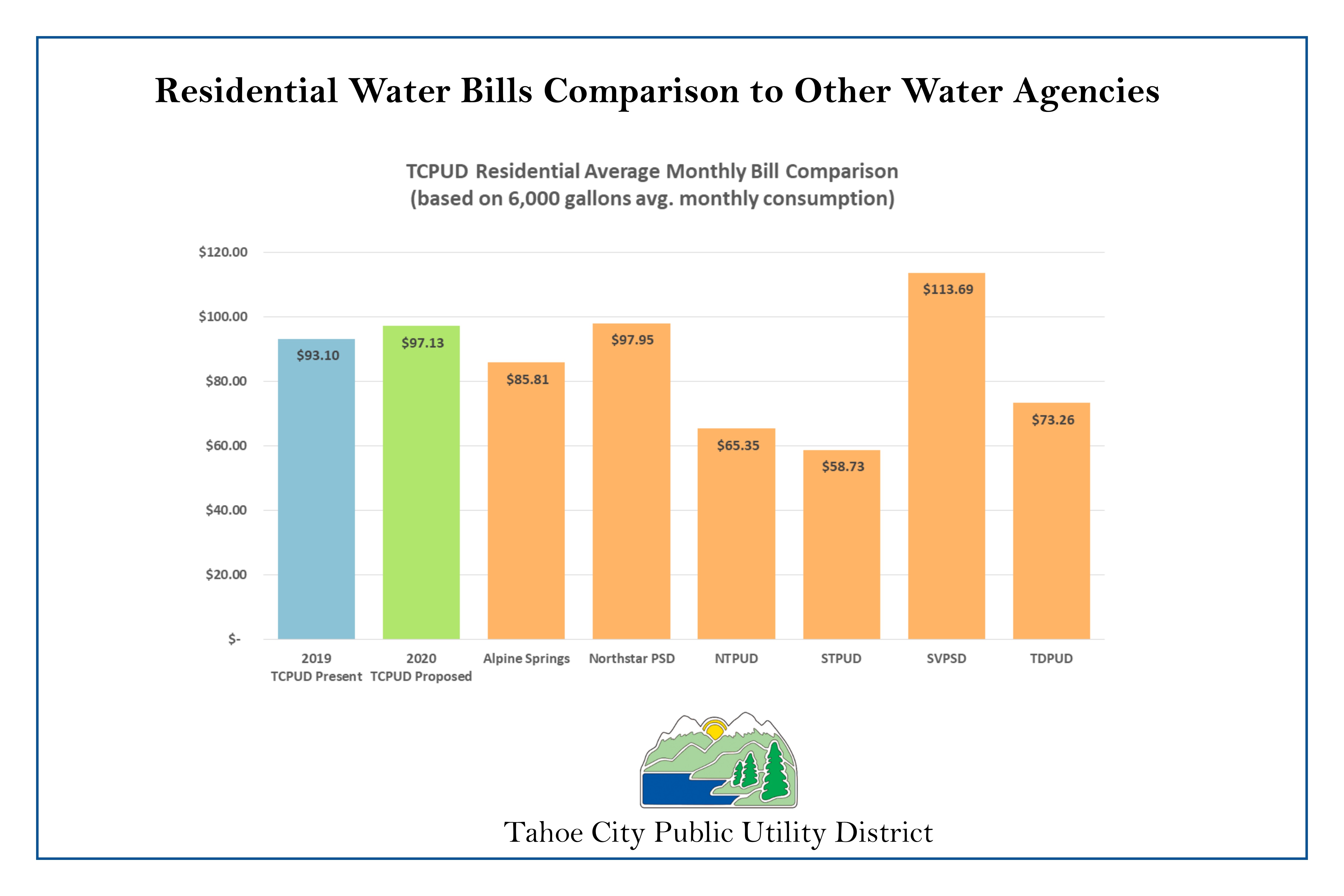
Why do TCPUD water and sewer rates seem higher than other areas?
Many people express concern and have questions about water and sewer rates at Lake Tahoe as compared to other areas in California or Nevada. There are numerous factors that contribute to TCPUD’s rate structure as described below. More importantly, customers are protected by revisions to the California Constitution voters approved under Proposition 218. These provisions prevent public water and sewer agencies from collecting higher rates than what is needed to provide the service. Below are descriptions of some of the cost factors that affect TCPUD rates. Cost Factors:
All of these factors contribute incrementally to the higher overall cost of providing service to our customers. Your elected Board Members and TCPUD’s management team constantly evaluate every possible cost-savings and efficiency factor. We partner with other agencies and organizations to achieve the maximize benefits for the least cost. In addition we routinely run comparisons with other Districts in our region to ensure our rates are very comparable with those in the region.
|
||||||||||||||||||||||||||||
Why is so much of the water rate I pay “fixed” in the base charge so I pay even when I am not there?
In designing water rate structures there are two competing objectives:
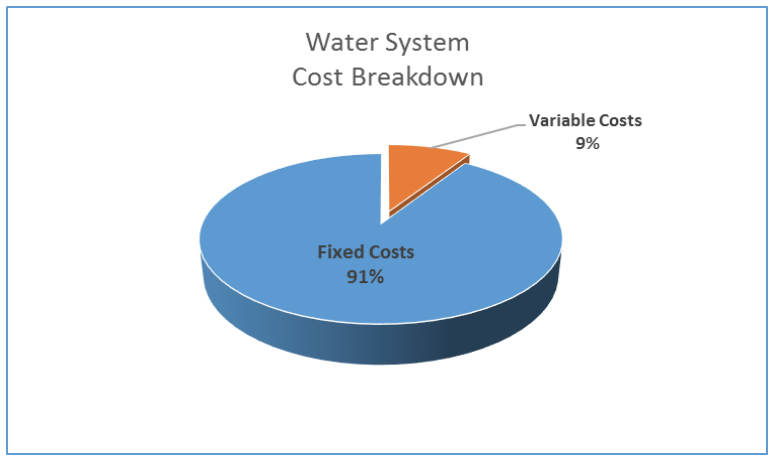
Public agencies across California balance these two factors in setting their rates, based on their own specific circumstances and type of population. They create a mixture of fixed or “base” rates along with consumption or “volumetric” rates in order to collect the revenues necessary to provide the service. 91% = FIXED COSTS: The vast majority of costs for delivering potable water anywhere in the state are fixed, meaning they only vary slightly based on actual water use. Maintaining millions of dollars of infrastructure and meeting increasing state and Federal water quality/consumer protection requirements are 91% of our total costs. This is similar to most other water agencies in the State. 9% = VARIABLE COSTS: These costs fluctuate on the amount of water used and are made up of pumping and treatment costs only.
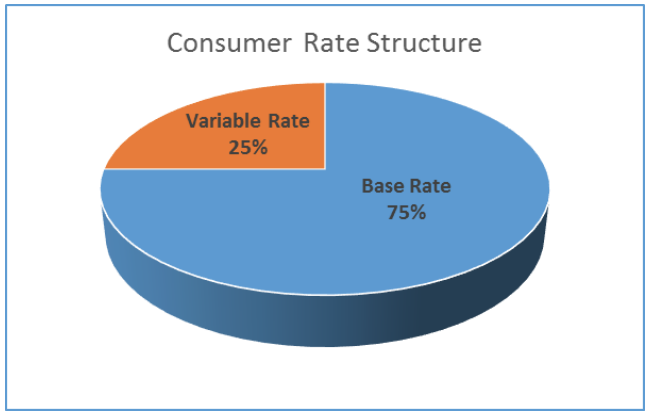
If these percentages were put into a formula, TCPUD would bill 91% of its water service cost in the base rate and only 9% in consumption. However, in to better comply with conservation objectives and provide customers an opportunity to control the level of their bill, TCPUD uses a formula that receives only 75% of the revenue from base rates and 25% from consumption (variable) rates. This rate structure works towards the competing objectives established by the State and fully funds the cost of providing you water.
WIDELY FLUCTUATING POPULATION MAKE THE BASE RATE CRITICAL: Other areas of the state with stable year-round populations can depend upon collecting more of their fixed costs through their consumption rates, as customer usage characteristics are more uniform and predictable. They know that if people are in a home, they can depend on them using some amount of water. Within TCPUD, over 80% of our homes are not occupied year-round. However, we must be staffed and able to provide water service to our customers whenever they arrive. In addition, we must operate our water system to provide full fire protection whether they are occupying their residence or not. In areas such as Tahoe, widely fluctuating occupancies can leave a water system unable to support itself if too much of the revenue is dependent on the consumption rate. The base charges provide a method to equitably collect a portion of the fixed costs on the system, which benefit all customers regardless of consumptive use, while still maintaining a conservation-oriented rate to reflect the cost of increased consumption. |
Are water restrictions over?
The TCPUD is currently in Water Conservation Stage Two (Moderate Water Shortage). In addition to individual conservation efforts, the following restrictions are in place:
The State of California is serious about protecting our water resources, continuing efforts towards drought resiliency, and making water conservation a regular way of life. Simple steps such as not letting water run when brushing your teeth or doing the dishes, ensuring your toilets aren’t stuck running, and fixing water leaks right away make a big difference. Be sure to take advantage of the TCPUD water efficiency rebate program for water efficient toilets, dishwashers, clothes washers and smart irrigation controls. Rebates up to $100 are available per appliance/fixture and water conservation kits are free for District customers. |
How can I reduce water consumption while having a landscaped yard?
|
How much water does a lawn need?
A well maintained lawn typically requires an average of 1-inch of water per week. This is approximately 62 gallons per week per 100 square feet of lawn. The cooler spring and fall will require less than this and mid-summer may typically require a little more. |
How much water use is normal indoors?
According to the American Water Works Association, before implementing basic water conservation techniques, the average indoor use is approximately 60 to 70 gallons per day per person. That translates into approximately 3,600 to 4,200 gallons per month for two people or 7,200 to 8,400 gallons per month for a family of four. Simple conservation measures can typically result in a 15-20 percent reduction in this number. The District is asking our customers to aim for a goal of 50 gallons per day per person, as an important part of our water conservation efforts. What can I do to conserve water indoors?
|
How much water use is normal outdoors?
It is extremely difficult to determine how much outdoor water use is normal. It varies greatly depending on amount of turf, types of plants, type of irrigation system, soil type and weather. There are many resources on the internet to assist you with proper landscape maintenance. You may also contact any qualified landscape contractor in the area for further assistance. |
How often should I water my lawn or landscaping?
It is recommended to only irrigate three times per week. This will allow water to saturate deeper and promote deeper root depths. Deeper root depths provide better protection from heat stress, and disease, and greatly improve the appearance of a plants and lawn. |
How should I take care of my established lawn?
The District strongly recommends native plants instead of lawns and turf. However, if you have an existing, established lawn and want to keep it, the following tips are recommended to save water and to make your lawn healthier:
|
I like to water my yard to keep the threat of fire down, is that a good idea?
Simply watering your yard is not the answer to protecting your home from a wildfire. To reduce the fire risk around your home, use basic defensible space techniques. For more information on Defensible Space, please contact your local fire protection district (North Tahoe Fire Protection District or Meeks Bay Fire Protection District) or visit the following website: http://www.livingwithfire.info/tahoe/ |
What can I do to save water outdoors?
|
Who can help me create a landscaped yard with low water usage?
Contact your local nurseries for more information on the types of landscapes and plants that use less water. There are many qualified local landscape contractors who can assist you with design and installation of water friendly landscape designs. You can also contact the Tahoe Resource Conservation District for a free site-specific visit and assistance in creating a landscape with low water usage. |
Why are my water rates so high?
For answers to this question and others regarding the District’s rates, please view our Water and Sewer Rates FAQs. |
Won’t watering at night create disease in cold-weather turf?
No. Fungus or turf diseases will occur when conditions are ideal, regardless of when you water. Using the smallest amount of water needed for your turf will prevent overwatering and keep your turf healthier. |
Are garbage disposals allowed?
Commercial garbage disposals that discharge into the public sewer system are not allowed. Screens should be installed in all sinks receiving food waste, and all collected material shall be placed into the garbage. |
Can I use chemical or biological agents to reduce grease?
No; the use of chemical and/or biological agents to dissolve FOG is not allowed. These additives simply move the grease into the sewer system; they don’t actually eliminate it. If you have been using these materials, you must discontinue their use. Contact the District to learn about alternative grease control measures. |
How can an FSE limit FOG discharge into the sewer system?
By using Kitchen Best Management Practices, also known as “Kitchen BMPs,” these are practices, procedures and maintenance activities performed by Food Service Establishments to reduce FOG in their wastewater discharge. They include:
The District has a FOG BMP Chart that we can provide to you. Additionally, the District has bilingual laminated posters for display in the cooking area of your FSE, and dish squeegees to wipe plates and cooking dishes before they are washed. Please contact us for these FREE materials. |
How do I dispose of the FOG?
Grease traps can be cleaned by the FSE, and you may either contract with a grease hauler to remove the waste or, once properly bagged and mixed with kitty litter, the sanitary landfill may accept it. Grease interceptors must be pumped by a pumping service that you contract with. The District has a list of companies that perform pumping services in this area. This list is shown on the following page. |
How do I keep FOG from going down the drain?
There are some simple ways to deal with FOG used or generated during cooking. Drain excess grease and oil from cooking into a used or empty glass jar or metal can. If not full, save the can in the refrigerator or freezer for the next time, or simply throw the container into the garbage. For pots, pans and dishes, dry wipe them with a paper towel prior to rinsing, washing, or placing in the dishwasher. The paper towel can then be thrown into the garbage. These procedures will greatly reduce the amount of FOG that you discharge into the sewer system. Additionally, you can stop by the District’s Administrative Office on Fairway Drive to pick up your FREE reusable cooking grease and oil disposal container, complete with directions and heat-resistant liners to use instead of a glass jar or metal can. |
How does FOG from FSEs cause sewer spills?
When wastewater from FSEs contains grease, the hot water and soap used in washing dishes emulsifies (breaks up) the grease, allowing it to flow freely through the sewer. As the wastewater cools, the grease congeals (hardens) causing blockages, which can lead to backups and overflows of sewage. Regardless of whether the blockage occurs within the FSE’s plumbing, the FSE’s sewer line, or the District’s sewer main, a costly and environmentally damaging sewer spill or backup may occur within your building or outdoors. Grease removal devices like traps and interceptors are designed to prevent FOG-related overflows. |
How does FOG from residences cause sewer spills?
When wastewater from residential kitchens contains grease, the hot water and soap used in washing dishes emulsifies (breaks up) the grease, allowing it to flow freely through the sewer. As the wastewater cools, the grease congeals (hardens) causing blockages, which can lead to backups and overflows of sewage. Regardless of whether the blockage occurs within your residential plumbing, your sewer line, or the District’s sewer main, a costly and environmentally damaging sewer spill or backup may occur within your home or outdoors. |
How much is a FSE License Fee and what is the money used for?
The FSE license fee for 2015 is $25.58 per month ($76.74 per quarter) and will appear on your regular billing statement. This fee is required per District Sewer Ordinance, Section 8 for all FSEs, as FSEs can contribute FOG to the District’s sewer system. FOG in the sewer system requires additional District time and resources to keep sewer lines and sewer lift stations operating correctly, in order to prevent sanitary sewer overflows from occurring. Additionally, the fees collected help to cover District costs for providing staff to assist you with Kitchen Best Management Practices, assist you with sizing and installing new grease reduction devices, perform discharge sampling, perform routine televised inspections of the building sewer laterals, and perform monthly grease interceptor inspections. |
How often should I clean my grease trap or interceptor?
Our staff will help you determine the optimum frequency for grease trap and interceptor service based upon your specific facility. As a reference, grease traps are often cleaned once a week and grease interceptors pumped out once per month. The cleaning frequency will vary due to the type of cuisine, number of meals served and size of your FOG control device. The equipment manufacturer may also have recommendations on the frequency of cleaning and maintenance required. |
Is my existing grease trap or interceptor adequate?
The size of your FOG control device depends upon the number of fixtures connected to it and the maintenance schedule. District staff will help you to determine if your existing trap(s) or interceptor is properly sized. If properly sized and frequently cleaned, you should be able to meet the discharge limit of 400 mg/L of FOG. If your discharge exceeds this limit, you may be required to install alternative or additional FOG control devices. |
What are Kitchen Best Management Practices?
Also known as “Kitchen BMPs,” these are practices, procedures and maintenance activities performed by commercial establishments and residential customers to reduce FOG in the wastewater discharge. They include:
|
What is FOG?
FOG is the acronym used to collectively refer to Fats, Oils and Grease. FOG can be defined as, “Any substance such as a vegetable or animal product that is used in, or is a byproduct of, the cooking or food preparation process, and that turns or may turn viscous or solidifies with a change in temperature or other conditions". |
What is the difference between a grease trap and an interceptor?
An interceptor is a large concrete box partitioned off to remove FOG and food waste by trapping particles that float to the top and particles that settle to the bottom. A grease trap is a smaller unit, often stainless steel, which works by the same principles. Typically, interceptors are installed in the ground outside of an FSE, and grease traps are installed indoors, often under a sink or counter. Grease traps, if approved through a District variance, are usually reserved for small establishments with low FOG output. Because grease traps are smaller, they are less efficient and require more frequent servicing. |
What types of businesses are considered to be FSEs?
Any commercial business that prepares food or washes any equipment, dishes, etc. that comes in contact with food is considered to be a Food Service Establishment (FSE). Some examples of FSEs include: restaurants, fast food establishments, convenience stores with food preparation, butcher shops, hotels, motels, bed & breakfast establishments, coffee shops, ice cream shops, commercial kitchens, delis, catering facilities, etc. |
What types of waste or household items should or should not be disposed of in the sewer system?
Only bodily wastes, and single-ply toilet paper should go into the toilet and then into the sewer system. Soap residue from dishwashers, kitchen and bathroom sinks, showers, bathtubs and washing machines can also go into the sewer system. Things that should NEVER be put into the sewer system include:
Did you know?
|
When is a sample port required?
All FSEs must have a sample port located just outside of their structure. New or remodeled FSEs must install the sample port as a part of the permit process. Discharge collected from sample ports will be analyzed to determine if existing FOG control measures are keeping kitchen wastewater below the limit of 400 mg/L of FOG, as set by District Sewer Ordinance 255, Section 8. |
When is FOG control equipment required?
FOG control is required on all facilities that may introduce FOG into the sewer system. If FOG control is warranted, based on the Uniform Plumbing Code and the California Plumbing Code, District Sewer Ordinance 255, Section 8 requires that a grease trap or interceptor be installed under the following conditions:
|
Why do I need a FSE license?
The license, issued annually, will identify the contact person for the FSE, and by their signature on the license, the District can ensure that they are informed of these FOG control requirements. Annual renewal will ensure that both the property owner and FSE are aware of any change in District regulations. The license application will provide information to District staff that will help us ensure that your FOG control measures are adequate and current. |
Why is FOG control necessary? Why should FOG not be put into the sewer system?
Fats, Oils, and Grease can gather in the sewer system causing blockage of sewer flows, resulting in sanitary sewer overflows. The California State Water Resources Control Board requires sewer utilities to develop and enforce a FOG control program to help prevent these types of sewer spills. District Utility Department staff members’ time is frequently spent using costly hydraulic equipment to remove built-up grease from the sewer system. |
Are there different types of backflow prevention assemblies?
Yes, there are several different types of backflow prevention assemblies, which are listed below:
The Tahoe City Public Utility District (District) recognizes all of these as acceptable forms of crossconnection control. However, each assembly must be approved prior to installation to ensure that the assembly is on the approved list and that the type of assembly used shall be based on the existing or potential degree of hazard. |
Can my backflow prevention assembly be installed in an underground box or vault?
Backflow prevention assemblies are designed to be installed above-ground. However, because of our severe winters, the District may approve the installation of a DC within an underground box, on a case-bycase basis. RPs and vacuum breakers may never be installed in a box or vault, as this installation would subject the assembly to potentially becoming submerged in the underground box or vault, rendering it ineffective. (RPs and vacuum breakers are open to the atmosphere, which, if submerged, would create another cross-connection). |
Can my backflow prevention assembly freeze?
Yes! Backflow prevention assemblies, particularly irrigation assemblies, will freeze if left exposed. They must be kept from freezing by providing insulation and by providing a heat source, if needed. Irrigation assemblies are recommended to be installed with unions on either side, which will allow them to be removed during the winter months. Other assemblies can often be installed within the building in a heated area. District staff will help determine what location is appropriate for the assembly. We will endeavor to allow you to install the assembly within the building to prevent it from freezing |
Do I need to install a backflow prevention assembly on my residential irrigation system?
Yes, even if it is a drip irrigation system. Weed killers, fertilizers and animal waste may enter the water supply through an irrigation system that is not properly protected with a backflow prevention assembly, contaminating the water. District staff will help you determine which assembly is the right one for your particular needs. |
Does a fire sprinkler system need a backflow prevention assembly?
Yes. In our cold climate, fire sprinkler systems are typically charged with a glycol solution. Additionally, systems constructed out of black iron pipe typically contain a rust inhibitor. Even systems that are charged only with water may be hazardous to the water supply. Bacterial growth can occur in the stagnant water, which sits undisturbed in the pipes for many years. A loss of system pressure can draw this polluted or contaminated water into your own system and potentially into the District’s water supply. Systems that are charged only with air, but include a Fire Department Connection (FDC) also pose a hazard to the water supply; if the FDC is connected to a fire truck during a fire situation, the potential exists for water that may contain other substances to backflow into the drinking water supply. |
Does my backflow prevention assembly have to be installed immediately behind my meter?
Not for most hazards. However, when there is an auxiliary water supply, medical facility, lethal hazard, failure to allow the District to perform a cross-connection inspection, or other circumstance, as determined by the District, backflow prevention assemblies must be installed immediately behind the meter, on private property. RP backflow prevention assemblies installed at the meter must be installed in an above-ground, continually heated enclosure. DC backflow prevention assemblies installed at the meter may be installed in an underground box or vault, but must be approved on a case-by-case basis. In general, the District has taken the approach of requiring internal protection with regards to the installation of backflow prevention assemblies, in order to protect the drinking water within the property as well as the public water system. This approach has been determined to be the best method for the protection of public health and safety. Furthermore, requiring internal protection, at the point of potential cross-connection, typically allows our customers to install smaller backflow prevention assemblies within their structure, and generally eliminates the need to house these assemblies in an above-ground, continually heated enclosure. |
How can I prevent contamination of my own home and the public water system?
You can determine if your property has any potential cross connections by completing a CrossConnection Survey on our website at http://www.tcpud.org/download/general/15ccs.pdf or by calling the Compliance Services Division to schedule a Cross-Connection Control inspection. Please note that you are also required to install an approved backflow prevention assembly on any identified cross-connections per District requirements and to test this assembly annually. |
How do I get a copy of the District’s test form?
This form is available on the District’s website: TCPUD Backflow Prevention Assembly Test Report (January 2015). Alternatively, you can call the District and request that a copy be emailed, faxed or mailed to you, or stop by the office to pick one up. |
How do I know when my backflow prevention assembly needs to be tested?
The District maintains a database containing all of the permitted backflow prevention assemblies within our water system. We will notify you when your assembly is due to be tested, and we will provide you with a test form accompanied by a list of certified Backflow Prevention Assembly General Testers. It is the customer's responsibility to schedule the test with the tester. These notifications are typically sent out in March of every year, with a typical test due date of the end of May. Mark your calendars to have your assembly tested every spring! |
How do I know which assembly I need?
The District can tell you which type of assembly is appropriate for your particular need. You may then choose the specific model from a list of approved assemblies available at the District office, or you can work with a Backflow Prevention Assembly General Tester or Cross-Connection Control Specialist to select a specific assembly. |
Is the Tahoe City Public Utility District required to comply with these same regulations?
Yes. The District owns and maintains 42 backflow prevention assemblies throughout our service area. We test all irrigation assemblies prior to first use each season, and test the remaining assemblies by the same due date as our customers. |
My backflow prevention assembly is installed. Now what?
The installation of the assembly must be inspected and approved by the District. Call the Compliance Services Division to schedule an inspection. After the installation has been inspected and approved, the assembly must be tested. Per California State Law, all backflow prevention assemblies must be tested upon installation. A District-approved, certified Backflow Prevention Assembly General Tester must test the assembly to ensure that it is operating correctly and will complete the District’s “Backflow Prevention Assembly Test Report”, available on our website or at our office. The tester will then mail, fax, or email the completed form back to the District. |
What causes backflow?
There are two conditions that can cause backflow:
|
What happens if I don't install a required backflow prevention assembly?
Failure to install the required type of assembly could result in termination of water service as described in the District’s Water Ordinance 263. The District will work with you to ensure that you are able to install the assembly, by selecting a location that would allow for the smallest size and fewest amount of assemblies, if more than one assembly is required. The District will also work with you to select a due date that is reasonable given your budget and schedule, while still addressing this matter in a timely fashion. |
What is "backflow"?
Water normally flows in one direction, from the public water system through your water service, to your plumbing fixtures. However, under certain conditions water can flow in the reverse direction – creating “backflow”. Backflow can contaminate the water supply and cause serious health issues. Backflow is the reverse flow of non-potable water or other substances through a cross-connection hazard into the piping of the consumer's potable water system or the public water system. |
What is a "cross-connection"?
A cross-connection is an actual or potential connection between a public water system or consumer's potable (drinking) water system and any source or system containing non-potable water or other substances. (Non-potable water is water that is unfit or unsafe to drink.) |
What is a backflow prevention assembly?
A backflow prevention assembly is a mechanical device that prevents water from "backflowing" into a potable water system (either the consumer’s internal system, the public water system, or both). |
What is a stop and waste drain/valve? Why is it a potential cross-connection?
A stop and waste drain and a stop and waste valve are the same thing. A stop and waste valve is used to drain the piping above or beyond it, when it is in a closed position. These are typically used on irrigation lines and for domestic water service lines. These can be a potential cross-connection if the stop and waste valve is installed below the ground surface; the water (including any contaminants, such as chemicals, dirt, bacteria, fertilizer, etc.) can pool up and then enter your internal plumbing and potentially the drinking water system through the valve when it is opened back up. The California Plumbing Code and the District requires that “Combination stop-and-waste valves…shall not be installed underground.” |
What is a yard hydrant or frost-free hose bibb and why is it a potential cross-connection? Are there “approved” yard hydrants?
A yard hydrant and a frost-free/freeze proof hose bibb are the same thing. A yard hydrant is an outdoor water supply outlet that has a valve and outlet above ground and a drain opening below the frost level. When the valve is opened, water flows. When the valve is closed, the water supply to the hydrant is shut off below the frost level and a drain hole is opened that allows the water in the yard hydrant pipe to drain into a gravel bed. This drains the yard hydrant and its riser so that the hydrant will not freeze. A yard hydrant can be a potential cross-connection through the drain hole; when a backsiphonage condition occurs, contaminants (such as chemicals, dirt, bacteria, fertilizer, etc.) can potentially enter your internal plumbing and the public drinking water system through the drain hole. The District requires that yard hydrants have an RP assembly installed upstream of them, or that they are replaced with a sanitary yard hydrant. A sanitary yard hydrant still has a drain hole, but the water drains into a sealed tank. When the hydrant is turned on again, the water in the tank is expelled; there is no crosscontamination with the yard hydrant and the soil. |
What is an auxiliary water supply and why is it a potential cross-connection?
An auxiliary water supply is a water source on your property in addition to the public drinking water service. An auxiliary water supply can be any one of the following: well, lake intake, stream/river intake, spring, rainwater cistern, grey water, etc. When there is an auxiliary water supply on a property, it can be a potential cross-connection if that auxiliary supply accidentally gets connected to the public drinking water supply. For example, if your property has a lake intake or a private well that feeds your irrigation system, but your irrigation system is also fed from the public water system, the water from the auxiliary supply could get into the public drinking water system. For properties with an auxiliary water supply, the District requires an approved backflow prevention assembly to be installed at the meter. |
What kinds of hazards do appropriate backflow prevention assemblies protect from?
Backflow prevention assemblies protect against two types of hazards: pollutants and contaminants.
|
Who can install and test the assembly?
A plumber, fire sprinkler contractor, landscaper, Backflow Prevention Assembly General Tester, or anyone with plumbing expertise can install an assembly. However, only Backflow Prevention Assembly General Testers holding current certification by the California-Nevada Section of the American Water Works Association (AWWA) can test, maintain and repair backflow prevention assemblies. The tester must provide the District with evidence of AWWA certification and proof that the test equipment he or she will use is currently calibrated. Click here for the TCPUD certified backflow tester list: |
Why do I have to test my backflow prevention assembly every year?
Title 17 of California state law and District Water Ordinance 263 requires annual testing of backflow prevention assemblies to ensure that they are functioning properly. With the exception of the air gap, backflow prevention assemblies are mechanical units with internal seals, springs, and moving parts that are subject to fouling, wear, or fatigue. The annual test ensures a properly functioning assembly, and certifies that the assembly has not been removed or had a by-pass line installed around it. Air gaps are “tested” by conducting a visual inspection. |
Why do I need to install a backflow prevention assembly?
In order to protect your family’s health and the public drinking water system, the State of California requires all water suppliers to maintain ongoing backflow prevention and cross-connection control programs so that your water is protected from hazards that originate on private property. The California Department of Public Health requires the District to eliminate cross-connections by maintaining these programs. The backflow prevention and cross-connection control program mandates the installation of backflow prevention assemblies by the consumer where the District determines they are needed, in accordance with Title 17 of California state law and District Water Ordinance 263. |